

With global regulations increasing and consumer demand for plastic-free packaging at an all-time high, businesses are facing an important question: “Can sustainable packaging hold up under real-world supply chain pressure?” Packaging Engineers cannot compromise the structural performance of sustainable packaging when replicating petroleum-based cushioning such as plastic bubble wrap or expanded polystyrene (EPS) foam. The solution lies in a structural design inspired by nature, which is “Honeycomb Paper Packaging.” For protection using paper as a replacement for plastic may sound unreal, but it is only possible with the right engineering. By transforming lightweight kraft paper into a continuous matrix of interconnected hexagonal cells, honeycomb paper packaging achieves an extraordinary strength-to-weight ratio.
This guide explains the engineering, real-world applications, performance load ratings, and the precise step-by-step methodology to specify honeycomb paper packaging for your business operations.
Why Honeycomb Carries Weight?
Geometry explains the unique mechanical properties of honeycomb paper packaging. A single sheet of paper has negligible compressive strength. However, when multiple layers of recycled or certified kraft paper are bonded with water-based adhesives in alternating, parallel lines and stretched, they form a 3D hexagonal network. This structure resembles a series of interconnected columns. When a vertical load is applied, the hexagonal cells spread forces evenly across the entire surface area, reducing localized stress points.
Primary formats of Honeycomb:
Flexible Honeycomb Wrap & Pallet Films
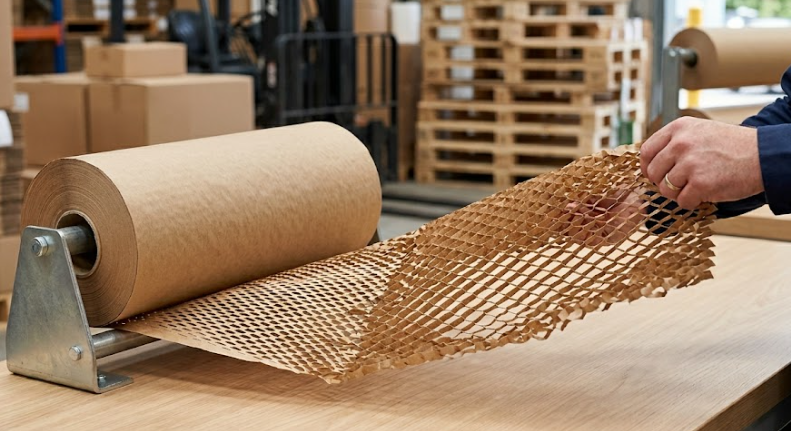
These are unexpanded rolls with precision, interlocking micro-die cuts. BOTTA EcoPackaging offers these high-expansion paper webs which expands 1.5 times their length and up to 60 times their original thickness, creating a flexible, self-locking cushioning blanket.
Rigid Honeycomb Boards & Panels
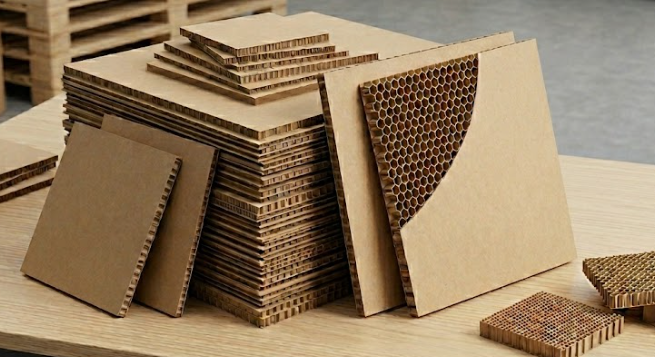
These consist of expanded cores sandwiched between two flat paper liner sheets. They form very rigid, flat panels used for structural void filling, edge protection, and heavy-duty dividers. BOTTA EcoPackaging offers these solutions in various sizes and thicknesses to fit custom industrial packaging requirements.
Industrial Applications of Honeycomb Paper
-
Protective Retail & E-Commerce Product Cushioning (Inside-the-Box Protection)
This application focuses on protecting individual products from shocks, drops, and surface scratches during shipping. Honeycomb paper packaging serves as a sustainable alternative to plastic bubble wrap, air pillows, and polystyrene peanuts. When stretched, this special paper puffs up into a neat 3D honeycomb shape that hugs products snugly. It works great for lightly shaped or round items too. No need for sticky plastic tapes, these pieces interlock perfectly, making packing up things in the warehouse easier and faster.
-
Palletization & Unit Load Containment (Around-the-Pallet Protection)
This application focuses on lightly securing multiple cardboard boxes onto a single wooden pallet. It keeps the load stable during forklift handling, sharp warehouse turns, and long-distance transport, while also stretching traditional single-use plastic stretch film. Instead, it uses high-tensile paper wrap with precise die-cut patterns that get activated under tension, creating a strong, layered structure around the pallet. The paper’s fibers are specially designed to get stiffer when stretched, which lets the wrap extend almost double its original length. In turn, this locks down uniform, room-temperature pallet loads up to 500 kg.
-
Logistics Void Filling & Cargo Stabilization (Between-the-Pallets Protection)
This application keeps loaded pallets from shifting, tilting, or colliding during transit by road, rail, or sea. Rather than inflatable dunnage bags, it employees an expandable accordion-style paper structure that fills gaps up to 65 cm when opened onsite. Its vertical honeycomb cells handle intense sideways force perfectly, while the heavy-duty versions tackle cargo shifts ranging from 1,300 kg to 3,000 kg. When not in use, it folds completely flat, reducing warehouse storage space requirements by up to 85% compared to conventional rigid dividers.
-
Industrial Edge & Corner Deflection (Outer Structural Protection)
This application shields the most vulnerable parts of heavy or bulk cargo, especially sharp edges and corners, from impact damage and crushing caused by tight tearing. It uses pre-formed, heavy-duty right-angle profiles made from compressed, multi-layered recycled paper, placed on pallet corners beneath plastic or steel straps. These rigid protectors act as a supportive outer frame, distributing strap pressure evenly and preventing boxes from buckling. They also serve as a controlled “crumple zone” in case of impacts during handling on busy loading docks.
Honeycomb Load Rating and Performance
A common misconception anticipating companies from moving towards eco-packaging is the myth that paper packaging lacks structural strength and is not as strong as the plastic one. In reality, paper becomes super durable when turned into a continuous hexagonal pattern or high-tensile band. So, its mechanical performance increases dramatically.
When evaluating paper packaging alternatives for supply chains, performance comes down to the following load ratings:
Capacity
When multiple boxes are stacked on a shipping pallet, centrifugal force during sharp truck turns or sudden forklift stops pushes the load outward. The packaging material must have enough tensile strength to hold everything together.
High-tension paper wrapping structures featuring engineered die-cut expansion windows are rated to stabilize uniform, ambient pallet configurations weighing up to half a ton (500 kg).
Performance: As the wrap is stretched around the pallet, the cut paper fibers lock into a rigid, multi-layered band. This band resists stretching out of shape over long hauls, matching the structural hold of standard plastic film.
Resistance
Inside a shipping container or trailer, empty spaces between adjacent pallets cause heavy cargo to tip sideways. The material used to fill these voids faces extreme horizontal crushing forces whenever the transit vehicle brakes or turns.
Expandable, folding accordion-style paper matrices are engineered to withstand massive lateral pressures, with standard variations safe stabilizing transit shifts ranging from 1,300 kg up to 3,000 kg.
Performance: This material uses a vertical cellular design, meaning any sideways pressure is spread evenly down an interconnected series of rigid paper columns. This allows it to bridge empty logistics gates up to 65 cm wide without collapsing or popping like traditional plastic inflatable air cushions.
Stiffness
For items packed inside parcel boxes, or for pallets stacked vertically on top of each other in a warehouse, the material must survive direct, downstream vertical weight without flattening out.
Depending on the configuration, rigid paper cell structures provide an average flat crush tolerance ranging from 15 to 50 kg/cm² (equivalent to 5 to 60+ PSI).
Performance: The ultimate load rating is directly governed by cell diameter and paper weight. Smaller hexagonal cell dimensions (such as 8mm to 10mm) create a denser network of vertical walls for square centimeter, exponentially increasing the flat crush threshold. Conversely, larger cells (12mm to 25mm) lower the load rating but create an ultra-lightweight profile optimized for filling open space.
Specifying Honeycomb Packaging Correctly
Transitioning away from plastic is not just about swapping materials, but it also needs strategic planning. To maintain complete structural protection, sustainable packaging must be strategically matched to your specific logistics blueprint.
STEP 1: Optimize and Consolidate
Group your products by size, weight, and fragility. Rather than procuring a separate custom box or wrap for every single item, opt for versatile, adaptive solutions like expandable paper webs or flexible sleeves. Streamlining your packaging architecture reduces warehouse complexity, minimizes SKU counts, and lowers your overall storage footprint.
STEP 2: Define the Structural Requirements
Sustainable packaging does its best when engineered to target specific mechanical forces. When requesting consultation, must specify your needs based on the exact type of physical stress your goods encounter during transit.
Effective paper-based packaging solutions should be selected according to the protection required. High-tensile paper pallet wraps help stabilize cargo during handling and transit, while corrugated inserts and molded pulp profiles absorb impacts and protect fragile products from drops. Lightweight expanding paper structures can also be used to fill empty spaces within shipping boxes, preventing product movement and enhancing overall package protection.
STEP 3: Align Dimensions with the Product Lifecycle and Material Compliance
During specifications on packaging solutions, consider both operational efficiency and end-of-life sustainability. Ensure cushioning fits standard box dimensions, and choose flat-packed, high-expansion profiles to reduce storage space.
We offer materials that are 100% recyclable and designed to be thrown directly into standard paper recycling streams, making waste management effortless for both your warehouse workers and end consumers.
STEP 4: Use the Custom Designing Phase
Provide our team with your exact asset dimensions, weight limits, and transit modes (road, maritime, or air). This data allows us to precisely configure the ideal choice, dimensions, and composition to deliver a tailored, damage-free shipping solution.
Partner with Us for Engineering Your Transition
Eliminate the uncertainty of moving away from single-use plastics. With over 78 years of structural cardboard expertise and three generations of innovation, BOTTA EcoPackaging helps you transform your transit operation from a logistics challenge into a competitive, circular advantage. We are ready to analyze your supply chain vulnerabilities, optimize your dimensions, and bring to you eco-friendly solutions that protect your cargo just as effectively as the planet.
References:
https://www.botta.it/en/?s=honeycomb+packaging&lang=en
https://pro-wpak.com/blog/honeycomb-paper-comparative-analysis-and-practical-applications/
https://dufaylite.com/blog/paper-honeycomb-packaging/
https://www.yamaton.de/en/solutions/paper-honeycomb-pallets/
https://www.ranpak.com/lp/eco-packaging/